Inspire, Dream, Book: What a Tourism Website Actually Needs to Do in 2026
Riding the "100% Pure" Wave
Tourism New Zealand invests millions of dollars in global marketing campaigns, such as their recent digital campaign launched in March 2026, titled “Come for a Slice of Home, Stay for the Adventure,” aimed at attracting international working holidaymakers and Australian leisure travellers. They also continue to promote their long-standing slogan, “Find Your 100% Pure New Zealand.” Additionally, they collaborate with large networks to increase visibility for Aotearoa.
But here is the hard truth for small Kiwi operators: Tourism NZ’s job is to make travellers Dream. Your website’s job is to make them Book.
If a traveller gets inspired by a TNZ ad, searches for your region, lands on your outdated website, and feels underwhelmed, they will bounce straight back to Google. They will end up booking your competitor on an Online Travel Agency (OTA) like Booking.com or Viator. That costs your competitor 20% in commission, but it costs you 100% of the sale.
The 2026 traveller to NZ is looking for slow travel, digital detoxes, and deep local immersion. They want off-grid mindfulness and community-led storytelling. A well-designed digital presence must inspire this connection long before the guest ever arrives.
Phase 1: Inspire (The 3-Second Vibe Check)
Inspiration dies instantly if a site takes six seconds to load. Google heavily penalises slow, clunky sites on mobile through its Core Web Vitals metrics. But beyond the technical speed, you have exactly three seconds to pass the visual "vibe check."
The modern 2026 traveller doesn’t want to read a wall of text about your history in the hero section. They want high-resolution, beautifully compressed video or imagery that immediately communicates your Unique Selling Proposition (USP).
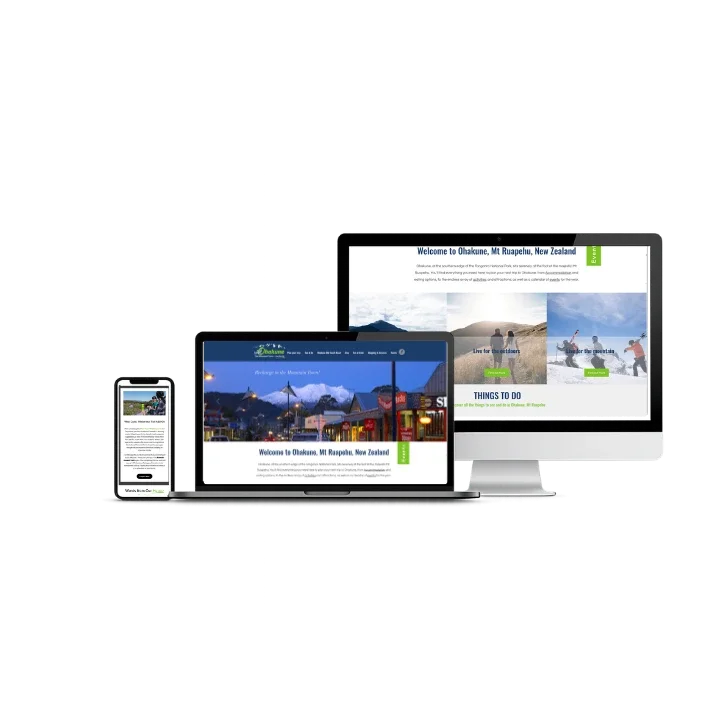
A modern tourism website should look clean, fluid, and conversion-focused. This means:
Ditching generic stock photos: Use authentic, high-quality imagery of actual guests experiencing your product.
Organic Layouts: Asymmetrical grids and gentle curves are replacing harsh rectangular boxes to mirror natural environments.
Restraint and Clarity: Generous white space, strong typography hierarchies, and fewer competing elements make scanning simple.
Immersive Motion: Subtle scroll-telling animations and micro-interactions guide the user naturally through your destination's story.
Phase 2: Dream (Building Trust & E-E-A-T)
Once you have their attention visually, you must build trust. In search engine terms, this is E-E-A-T (Experience, Expertise, Authoritativeness, and Trustworthiness).
Boutique accommodations and tour operators cannot compete with massive hotel chains on price. You must compete on experience. Your website must weave your uniquely Kiwi story—sustainability practices, local knowledge, whakapapa, or family history—directly into the copy. Travel trends in 2026 heavily favour independent local operators, driven by a consumer desire for authentic, community-rooted travel.
How to build this trust digitally:
Social Proof Integration: Don't bury TripAdvisor reviews on a hidden page. Dynamically pull recent, high-quality reviews onto the homepage. Furthermore, respond to them! Potential customers read reviews for social proof; by replying to reviews (good or bad), you showcase your hospitality character.
Generative Engine Optimisation (GEO): Modern search is shifting from simple keyword matching to conversational AI search (like Google AI Overviews and Gemini). OTAs rely on standardised, scraped data. Your custom site beats them by providing structured depth. If a user asks AI, "Is the driveway suitable for a 2WD campervan in winter?" or "Do you offer gluten-free cooked breakfast for early sunrise tours?", the AI pulls directly from your rich, hyper-specific FAQs, capturing high-intent traffic OTAs ignore.
Hyper-Local Content: An OTA won't write a guide titled "The Ultimate 3-Day Itinerary for Akaroa." A well-crafted blog post captures travellers in the Dream phase before they even open an OTA app.
Phase 3: Book (The Frictionless Conversion)
This is where design meets revenue. Let’s break down the math of the Direct Booking Mandate. If an operator gets 10 bookings a month at $300, and OTAs take 20%, they are losing $600 a month ($7,200 a year). A custom Squarespace site pays for itself in less than six months simply by shifting OTA traffic to direct bookings.
The Billboard Effect
More than 50% of travellers who discover an experience or lodge on an OTA will open a new browser tab and Google the business’s exact name before booking. They want to see if the official site has a better price, better photos, or more details. This is where you win or lose the direct booking:
The Failed Site: The traveller Googles "Kaikōura Eco Lodge." They click the official site. It loads slowly on mobile, the photos look like they were taken on an iPhone 6, the booking button is hard to find, and pricing is confusing. Result: The guest panics, bounces back to Booking.com, and books there. You just paid a 20% commission on a customer who was already standing on your digital doorstep.
The High-Converting Site: The traveller lands on a sleek, fast Squarespace site. They see high-res imagery, a clear badge that says "Best Rate Guarantee & Free Breakfast when you book direct," and a floating 1-click booking button. Result: Direct booking captured. Commission saved.
Breaking the Commodity Trap
OTAs typically strip away your brand story, with generic content and strict word count, leaving the unique selling points of your business looking like everyone else's.
A custom website highlights the micro-moments OTAs bury—like the exact brand of local coffee in the room, the solar power system, or the private outdoor bath setup.
To capitalise on this, your user experience (UX) must be flawless. In 2026, if a user has to pinch-to-zoom to read a calendar widget on their phone, they are abandoning the cart. You need short forms (under six fields), direct 24/7 online booking integrated seamlessly, and a persistent, sticky "Book Now" button pinned to the screen.
The 2026 Technical Reality: Why Your Old Template is Costing You Money
Google hasn't cared about your desktop site for years. With Mobile-First Indexing, if your mobile experience is broken, your search rankings will be entirely suppressed.
Furthermore, as Google expands its native Hotel and Tour booking links, having clean Schema Markup (Structured Data) is critical. Search engines need to know your business coordinates, opening hours, pricing, and amenities in code format without having to guess.
Stop Gambling on Traffic. Start Plugging Revenue Leaks
A tourism website is not a digital brochure; it is a 24/7 sales agent whose primary KPI is reducing OTA commission leakage.
I am never going to sit here and promise you that a new website will magically double your traffic overnight; anyone who promises that in web design is lying to you. What a strategic website overhaul DOES do is stop your revenue from leaking.
Right now, if 100 people visit your site this month, a clunky mobile layout or missing details might cause 95 of them to leave or go book through an OTA. If a modern, strategic website improves your conversion rate so that just three or four of those people book directly with you instead, the site pays for itself.
A new website isn't necessarily a magic magnet for brand-new strangers. It is a highly optimised bucket that catches the high-intent visitors who are already looking for you, making sure they don't leak back to OTAs.
Are you losing direct bookings to clunky UX?
Let’s audit your site. Book a free, no-obligation Website Strategy Review to see exactly how much revenue a modern Squarespace site could save your tourism business this year.